
If you’re planning to install an EV charger or heat pump in your home, you’ve probably heard this:
“You’ll need to upgrade your electrical capacity.”
Sometimes that’s true. But more often, it’s not. Because here’s the thing: Many homes have more electrical capacity than people realize.
The challenge is that most homeowners and contractors don’t have an easy way to understand how much power their home actually uses.
Why Electrical Decisions Are Often Conservative
Most people know very little about their electrical panel. How many amps does your panel have? How much capacity is it actually using? Historically, the answers weren’t that important.
But as homes electrify with EV chargers, heat pumps, induction stoves, and electric water heaters, the panel suddenly becomes one of the most important systems in the house.
To stay safe and code compliant, electricians often rely on conservative calculations that assume multiple large appliances may run simultaneously at maximum power (NEC Article 220). But in many homes, real-world energy usage looks very different from those worst-case assumptions. Appliances cycle on and off, charging patterns vary, and peak demand is often much lower than homeowners expect.
That gap between theoretical maximum usage and actual day-to-day usage is where many homes may have more flexibility than they realize.
Research from Lawrence Berkeley National Laboratory (2026) examining thousands of homes found that the average electrical panel uses a maximum of about 38% of its total panel capacity. Study Link.
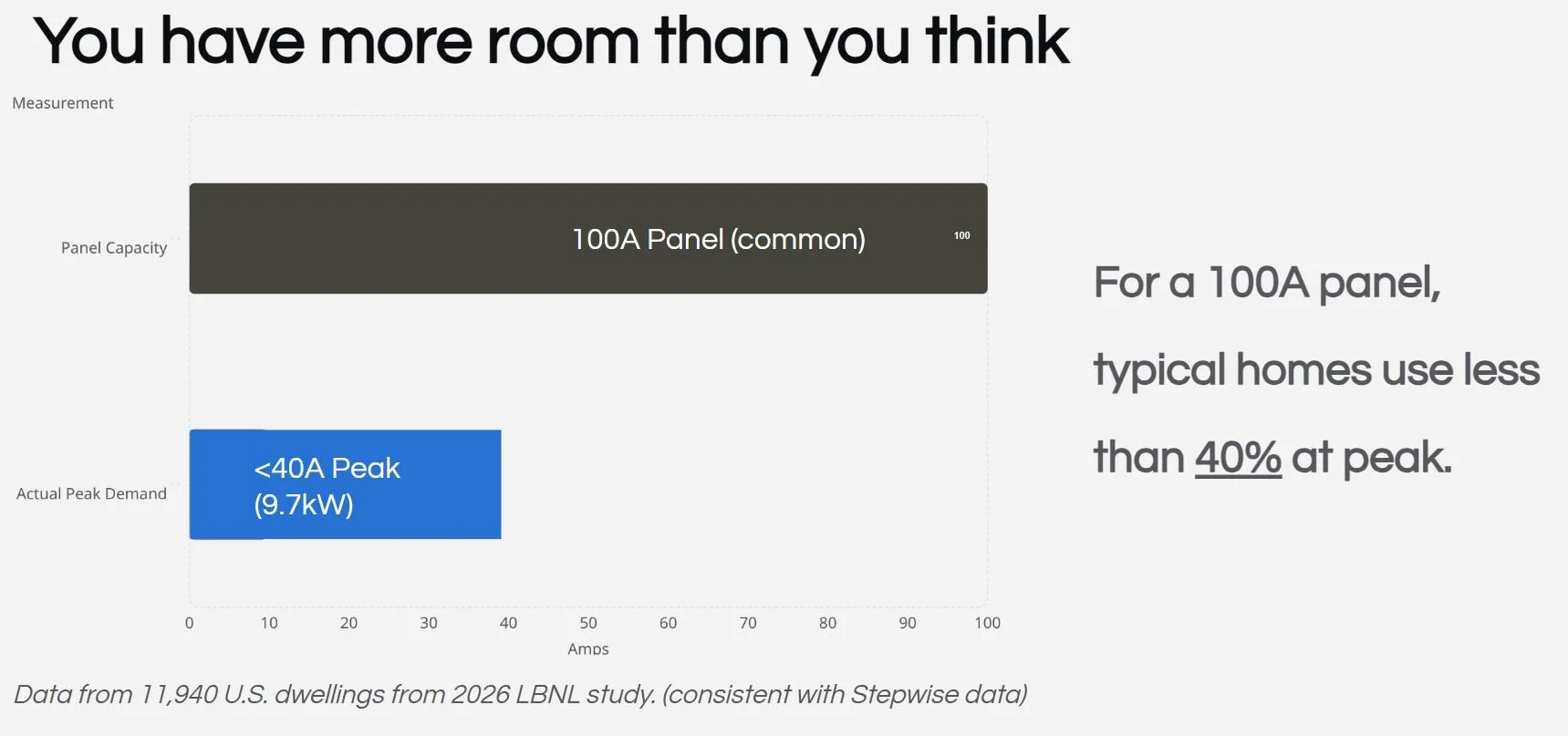
100A panels are the most frequently seen panel size; of those, the avg. maximum 15 min peak is <40A.
That doesn’t mean every home can automatically add new appliances without issue. But it does suggest something important: Many electrical systems are significantly underutilized most of the time.
The problem is that homeowners rarely have visibility into this.
Why This Matters For Electrification
When panel upgrades are recommended too early, the impact goes beyond just homeowner cost and delays.
For homeowners, upgrades can add $10,000 or more, along with permitting, utility coordination, and long installation timelines.
This is where the emergence of load management technology comes into play.
Traditional electrical panels are passive systems. They distribute power, but they don’t actively manage how electricity is used throughout the home.
Load management adds intelligence by:
Tracking your home’s real-time energy usage
Preventing overloads by managing large appliances dynamically
Helping plan future electrification with real usage data
Instead of immediately increasing service size, homeowners can sometimes optimize the capacity they already have.
Start with Understanding
The important first step isn’t deciding whether you need an upgrade. It’s understanding how your home actually uses electricity. That’s why we recommend starting with a panel assessment before committing to major electrical work.
If you want to learn more about how panel assessments work and what information they provide, read our guide here:
👉 Does Your Electric Panel Have Enough Capacity?
Or, if you want a quick evaluation of your specific home:
You may find your home has more flexibility than you think.